





AI Employees Are Coming: Will Your Next Coworker Be an Artificial Intelligence Agent?
For years, artificial intelligence has been viewed as a tool. We asked it questions, generated content, created images, and automated repetitive tasks. But something unusual is happening in 2026. AI is slowly moving beyond being a tool and becoming something entirely different: a digital employee.
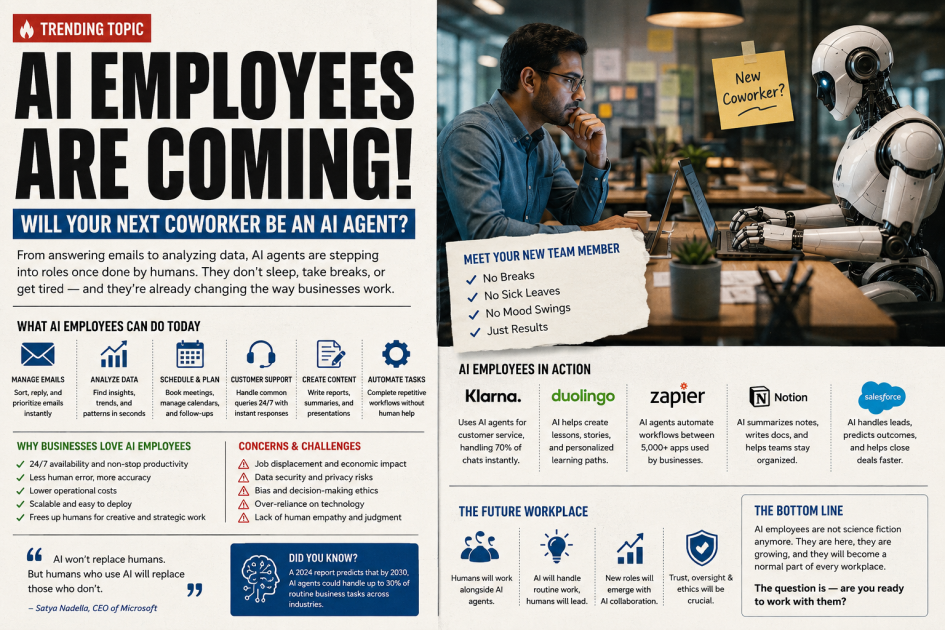
It sounds like science fiction, but some companies are already experimenting with AI agents that can perform tasks traditionally handled by human workers. These systems can answer emails, analyze reports, schedule meetings, create presentations, monitor customer support tickets, and even make recommendations based on company goals.
The question is no longer whether AI can assist employees. The question is whether AI can become one.
Imagine arriving at work and discovering that your newest team member isn’t a person sitting at a desk. Instead, it’s an AI agent operating 24 hours a day, seven days a week. It never takes breaks, never gets tired, and can process information far faster than most humans.
This concept is rapidly gaining attention because modern AI systems are becoming increasingly capable of handling complex workflows. Unlike traditional chatbots, new AI agents can remember context, plan multiple steps ahead, interact with software systems, and complete objectives with limited supervision.
For example, a marketing AI employee could monitor industry news, identify trending topics, create content ideas, draft articles, analyze traffic data, and suggest improvements without waiting for constant instructions.
A customer service AI employee could respond to common inquiries, escalate complicated issues, track customer satisfaction, and generate reports for management automatically.
Even software development teams are beginning to experiment with AI agents that review code, identify bugs, write documentation, and assist with testing procedures.
This shift is creating excitement and concern at the same time.
Supporters argue that AI employees could dramatically increase productivity. Businesses could operate more efficiently while reducing time spent on repetitive administrative work. Employees would have more opportunities to focus on creativity, strategy, relationship-building, and decision-making.
Critics, however, worry about the long-term impact on employment. If AI agents can perform tasks once handled by humans, what happens to those jobs?
Most industry experts believe the answer is more complicated than simple replacement. History shows that technology often changes jobs rather than eliminating them entirely. When computers became common, many feared widespread unemployment. Instead, entirely new careers emerged.
The same pattern may occur with AI employees.
Rather than replacing entire professions, AI is likely to automate specific tasks within those professions. A marketing professional may spend less time writing routine reports and more time developing creative campaigns. A customer support specialist may focus on complex customer relationships while AI handles basic requests.
Another challenge involves trust. Businesses need confidence that AI employees will make appropriate decisions. A mistake made by an AI agent could have financial, legal, or reputational consequences.
This is why many organizations are adopting a “human-in-the-loop” approach. AI can perform tasks independently, but important decisions still require human review and approval.
Security is another major concern. AI employees often need access to emails, documents, customer information, and business systems. Organizations must ensure that these systems are protected against misuse, data leaks, and cyber threats.
Despite these challenges, investment in AI agents continues to grow rapidly. Technology companies are racing to build platforms that allow businesses to deploy digital workers for a wide variety of tasks.
Some analysts predict that within the next five years, companies may manage teams that include both human employees and AI employees working together. Meetings could involve human managers collaborating with multiple specialized AI agents responsible for different business functions.
Whether this future arrives quickly or gradually, one thing is becoming clear: artificial intelligence is evolving beyond simple automation. It is beginning to take on responsibilities that once seemed uniquely human.
The workplace of the future may not be defined by humans versus AI. Instead, it may be defined by how effectively humans and AI work together. The organizations that learn to balance both could gain a significant advantage in an increasingly competitive world.
As AI technology continues to improve, the idea of having an AI coworker may soon feel as normal as having email, video meetings, or cloud storage. The future of work is changing, and digital employees could be one of the biggest transformations yet.