





Intel’s AI PC Revolution: Why the Chip Giant Is Betting Big on Artificial Intelligence
For decades, Intel has been one of the most influential companies in the technology industry. From powering personal computers to driving enterprise infrastructure, Intel processors have played a central role in the digital world. However, the rise of artificial intelligence has created new challenges and opportunities, forcing every major chip manufacturer to rethink its strategy.
In 2026, Intel is making one thing clear: the future of computing will be powered by AI. Through its latest Core Ultra processors, advanced manufacturing technologies, and AI-focused innovations, the company is positioning itself at the center of the next generation of personal computing.
The technology industry has changed dramatically over the past few years. Artificial intelligence is no longer limited to cloud servers and research labs. AI features are becoming a standard part of everyday computing, from content creation and video editing to productivity applications and virtual assistants.
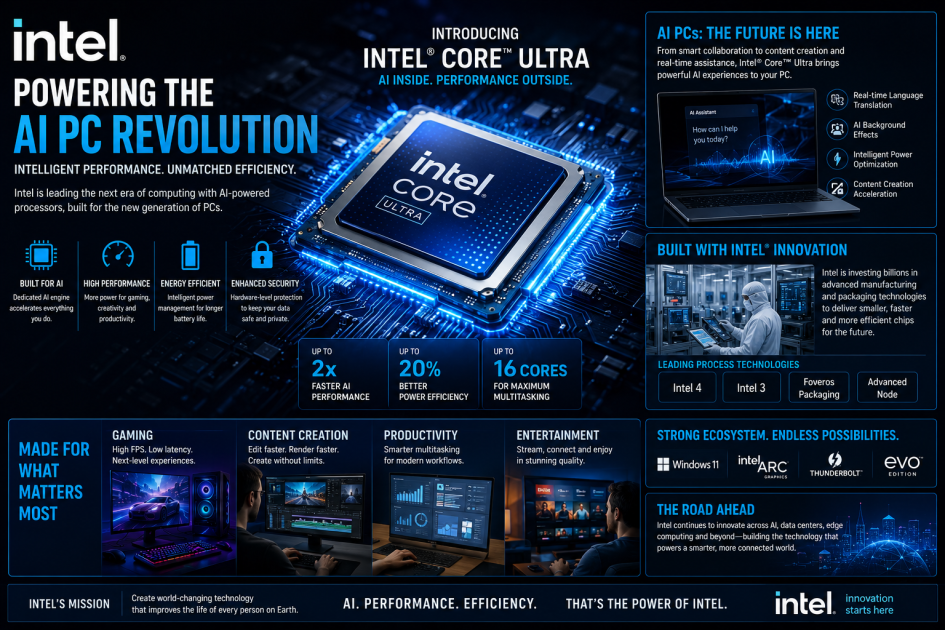
Recognizing this shift, Intel has focused heavily on developing processors designed specifically for AI workloads. The company’s latest Core Ultra series introduces dedicated AI processing capabilities that allow computers to handle AI tasks more efficiently while reducing power consumption.
Traditionally, CPUs were responsible for handling most computing operations. While modern processors remain incredibly powerful, AI applications often require specialized hardware. Intel’s new approach combines traditional CPU performance with dedicated AI acceleration, creating a more balanced computing platform.
One of the most significant developments is the introduction of Neural Processing Units, commonly known as NPUs. These specialized components are designed to handle AI calculations without placing additional strain on the CPU or graphics processor. As a result, users can run AI-powered applications more efficiently while improving battery life on laptops.
The rise of AI PCs is becoming one of the most important trends in the computer industry. These systems are capable of performing advanced AI tasks directly on the device rather than relying entirely on cloud services. This approach improves privacy, reduces latency, and allows users to access AI features even without a constant internet connection.
Intel believes that AI PCs will eventually become the standard for both consumers and businesses. Features such as real-time language translation, intelligent productivity tools, AI-powered video conferencing, and advanced content creation are expected to become common across future devices.
Gaming remains another important focus for Intel. Modern games require powerful hardware capable of delivering high frame rates, realistic graphics, and low latency. The company’s latest processors are designed to provide strong gaming performance while also supporting AI-driven features that enhance the overall experience.
Content creators are also benefiting from Intel’s AI investments. Video editing, image enhancement, 3D rendering, and streaming applications increasingly rely on artificial intelligence to automate complex tasks. By integrating AI acceleration directly into processors, Intel aims to help creators work more efficiently and reduce processing times.
Manufacturing technology is another area where Intel is making major investments. In recent years, the semiconductor industry has become highly competitive, with companies racing to develop smaller and more efficient chips. Intel has responded by expanding its advanced manufacturing capabilities and introducing new process technologies designed to improve performance and energy efficiency.
The company’s long-term strategy extends beyond personal computers. Intel continues to play a major role in data centers, cloud infrastructure, networking equipment, and enterprise computing. As artificial intelligence becomes more important across industries, demand for powerful processors is expected to grow significantly.
Despite facing strong competition from rivals in both consumer and enterprise markets, Intel remains one of the most recognizable names in computing. The company’s ability to adapt to changing technology trends will play a crucial role in determining its future success.
Industry analysts believe the AI PC market could become one of the largest growth opportunities of the decade. Millions of users are expected to upgrade their systems over the coming years to take advantage of new AI capabilities. This trend could create significant demand for Intel’s next-generation processors.
Looking ahead, Intel’s vision is centered on making artificial intelligence accessible to everyone. Rather than limiting AI to powerful cloud servers, the company wants to bring intelligent computing directly to personal devices. If successful, this strategy could reshape how people interact with technology on a daily basis.
In conclusion, Intel’s push into AI-powered computing represents one of the most important transitions in the company’s history. Through Core Ultra processors, AI acceleration technologies, and continued investment in advanced manufacturing, Intel is working to ensure it remains a major force in the future of computing. As AI PCs become more common, the company’s innovations could help define the next era of personal technology.