





Why SSD and RAM Prices Are Rising in 2026: Understanding the Market Shift
If you have recently checked the prices of SSDs or RAM modules, you may have noticed that they are becoming more expensive than they were a few months ago. After a period of falling prices and aggressive discounts, the memory market is once again moving upward. Industry analysts expect SSD and RAM costs to continue rising throughout 2026, affecting gamers, PC builders, businesses, and everyday consumers.
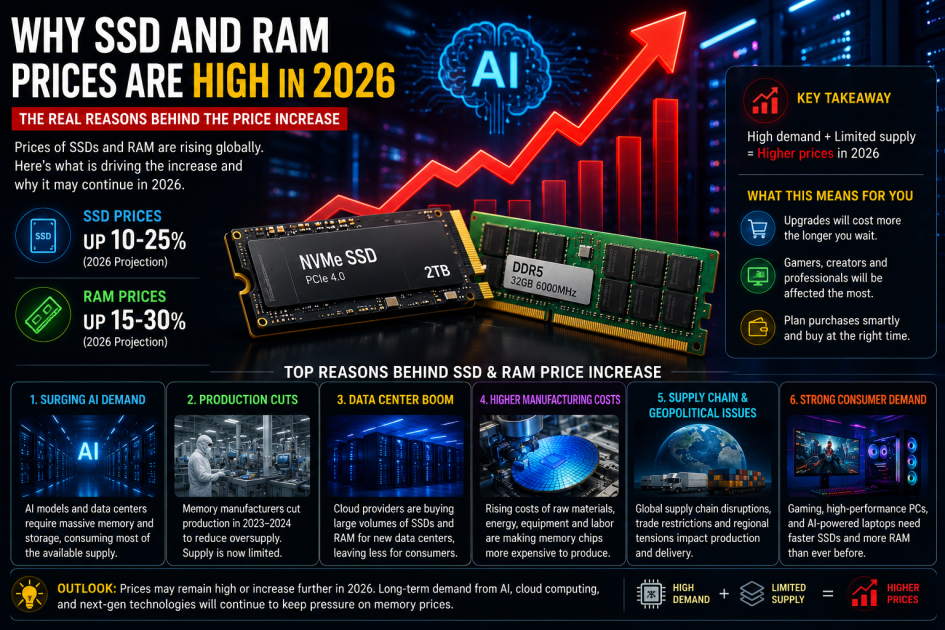
The biggest reason behind this increase is the growing demand for artificial intelligence infrastructure. Over the past two years, technology companies have invested billions of dollars in AI data centers. These facilities require enormous amounts of high-performance memory and storage to train and operate advanced AI models.
Unlike traditional servers, AI systems consume significantly larger quantities of DRAM and NAND flash memory. As demand from cloud providers and AI companies increases, manufacturers are allocating more production capacity to enterprise customers. This reduces availability for the consumer market and contributes to higher prices.
Another important factor is production control by memory manufacturers. During 2023 and 2024, memory prices fell sharply due to oversupply and weak demand. Companies such as Samsung, SK Hynix, and Micron responded by reducing production output to stabilize the market.
These production cuts successfully reduced excess inventory, but they also created tighter supply conditions. As demand recovered in 2025 and 2026, manufacturers found themselves operating with lower inventory levels. The result is a market where supply is no longer keeping pace with growing demand.
The rapid expansion of data centers is also influencing memory prices. Cloud computing providers continue to build larger facilities to support AI workloads, streaming services, enterprise software, and online applications. Every new data center requires thousands of SSDs and vast amounts of server memory.
This enterprise demand often takes priority because large corporate customers purchase components in massive volumes. As a result, fewer memory chips remain available for consumer-grade products such as gaming PCs, laptops, and desktop upgrades.
Manufacturing costs have also increased. Producing advanced NAND flash storage and modern DDR5 memory requires highly sophisticated fabrication facilities. Rising energy prices, labor expenses, equipment costs, and raw material prices have made semiconductor production more expensive overall.
Geopolitical uncertainty continues to affect the technology supply chain as well. Semiconductor manufacturing depends on a complex global network involving multiple countries. Any disruption related to trade restrictions, transportation issues, or regional tensions can influence component availability and pricing.
Gamers are already beginning to feel the impact. Modern games require larger storage capacities and faster memory than previous generations. As AAA titles continue to exceed 100GB in size, demand for high-capacity SSDs remains strong. At the same time, DDR5 memory has become the standard for many new gaming systems and high-performance PCs.
Laptop manufacturers are also contributing to demand growth. New AI-powered PCs launched in 2026 often require faster SSDs and larger memory configurations to support advanced features. This trend is increasing memory consumption across the entire technology industry.
Many market analysts believe that SSD prices could increase between 10% and 25% during certain periods of 2026, while RAM prices may see similar or even higher growth depending on market conditions. The exact increase will vary by region, product category, and manufacturer.
For consumers planning a PC upgrade, waiting too long could result in paying higher prices later in the year. Users considering storage or memory upgrades may find better value by purchasing sooner rather than delaying their purchases.
Despite the current increase, long-term demand for memory products remains strong. Artificial intelligence, cloud computing, gaming, and edge computing are expected to drive continued growth throughout the decade. Manufacturers are investing heavily in new production technologies, but it may take time before supply fully catches up with demand.
In conclusion, rising SSD and RAM prices are being driven by a combination of AI expansion, data center growth, production cuts, manufacturing costs, and global supply chain pressures. While higher prices may frustrate consumers, they also reflect the growing importance of memory and storage technologies in an increasingly digital world. For anyone planning a system upgrade in 2026, understanding these market trends can help make better purchasing decisions.