





Will Physical SIM Cards Disappear Forever? Why eSIM Is Taking Over
For more than three decades, SIM cards have been an essential part of mobile phones. Whether it was a large credit card-sized SIM from the 1990s or today’s tiny nano-SIM, every mobile user has interacted with a physical SIM card at some point.
But a major shift is now taking place in the smartphone industry. Technology companies and telecom providers are increasingly adopting eSIM technology, raising an important question: are physical SIM cards slowly disappearing?
The answer may be closer than many people think.
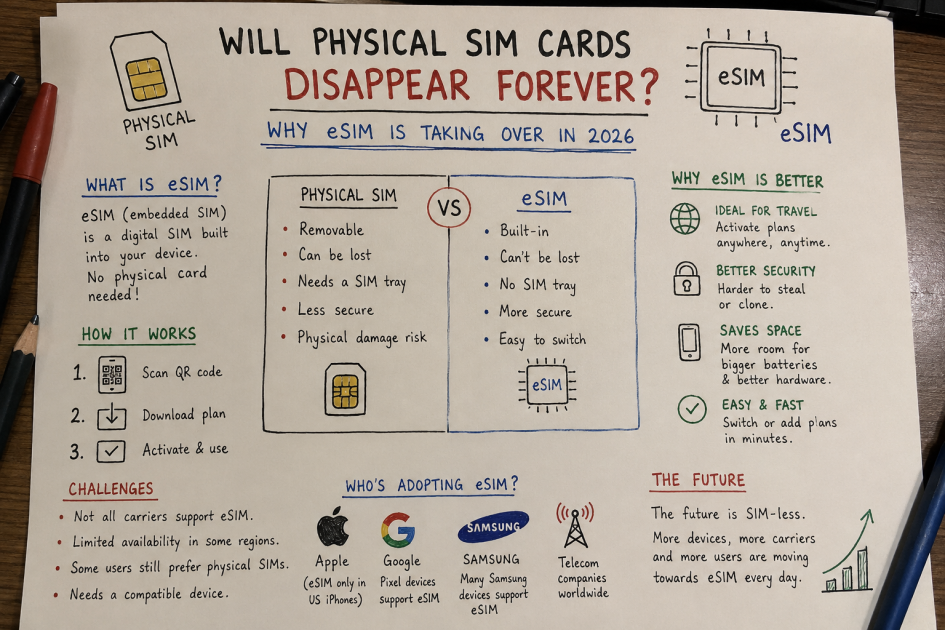
An eSIM, or embedded SIM, works differently from a traditional SIM card. Instead of inserting a removable card into a phone, the SIM functionality is built directly into the device. Users can activate a mobile plan digitally without needing to visit a store or swap physical cards.
At first glance, this might seem like a small change. However, it has the potential to transform how people connect to mobile networks.
One of the biggest advantages of eSIM technology is convenience. Anyone who has changed phones or switched network providers knows the hassle of finding SIM ejector tools, handling tiny SIM cards, and waiting for activation. With eSIM, most of these steps can be completed digitally within minutes.
Travelers may benefit even more. Instead of purchasing a local SIM card when visiting another country, users can simply download a temporary mobile plan through their phone settings. This makes international connectivity faster and more convenient than ever before.
Smartphone manufacturers are also embracing eSIM because it saves valuable internal space. Every component inside a modern smartphone competes for room, including larger batteries, improved cameras, cooling systems, and advanced processors.
By eliminating the need for a physical SIM tray, manufacturers gain additional design flexibility. While the space savings may seem small, every millimeter matters in today’s highly competitive smartphone market.
Water resistance is another benefit. Physical SIM trays create openings that must be carefully sealed. Removing these openings can help manufacturers design devices that are more durable and resistant to water and dust.
Security is also a major reason why eSIM adoption is accelerating. Traditional SIM cards can be removed and transferred between devices. While this flexibility can be useful, it can also create security risks in cases of theft or SIM swapping attacks.
Because eSIM profiles are digitally managed, telecom providers can implement additional security measures that make unauthorized transfers more difficult. As cybercrime continues to evolve, stronger mobile security is becoming increasingly important.
The rise of connected devices is further driving eSIM growth. Smartwatches, tablets, laptops, connected vehicles, and Internet of Things devices often rely on eSIM technology because there is no practical space for traditional SIM card slots.
As more devices become connected to mobile networks, eSIM provides a simpler and more scalable solution.
Major smartphone manufacturers have already started moving in this direction. Some premium devices launched in recent years support eSIM alongside traditional SIM cards, while certain regional models rely entirely on eSIM technology. Industry analysts expect this trend to continue as manufacturers gradually reduce their dependence on physical SIM hardware.
Telecom companies are also investing heavily in eSIM infrastructure. As activation processes become more streamlined, providers can reduce operational costs while offering customers a faster onboarding experience.
Despite its advantages, eSIM still faces challenges. Availability varies by region, and not all mobile carriers fully support digital activation. Some users also prefer the simplicity of physically removing a SIM card and placing it into another device.
There is also a learning curve for consumers who are unfamiliar with digital SIM management. While younger users may adapt quickly, widespread adoption will require continued education and support from both manufacturers and network providers.
However, the long-term direction appears clear. The technology industry has a history of removing physical components once digital alternatives become reliable enough. Headphone jacks, optical drives, and removable batteries have largely disappeared from mainstream devices. Physical SIM cards could eventually follow the same path.
In conclusion, eSIM technology represents one of the most significant changes in mobile connectivity since the introduction of smartphones. By offering greater convenience, improved security, better device design, and easier international connectivity, eSIM is steadily gaining momentum across the industry. While physical SIM cards may not disappear overnight, their future is becoming increasingly uncertain. The next generation of smartphones could be the first to leave traditional SIM cards behind completely.