





AI Cybersecurity Trends 2026: How Artificial Intelligence Is Protecting the Digital World
Cybersecurity has become one of the biggest challenges of the digital age. As businesses, governments, and individuals rely more heavily on technology, cybercriminals continue to develop increasingly sophisticated methods of attack. Traditional security systems that once provided adequate protection are now struggling to keep up with the speed and complexity of modern threats.
To address these challenges, organizations are turning to artificial intelligence. AI cybersecurity is rapidly emerging as one of the most important technology trends of 2026, helping security teams identify threats faster, respond to incidents more effectively, and strengthen defenses against evolving cyber risks.
The modern cybersecurity landscape is more complex than ever before. Companies face threats ranging from ransomware attacks and phishing scams to data breaches and advanced persistent threats. Security teams often manage thousands of alerts every day, making it difficult to distinguish genuine threats from false alarms.
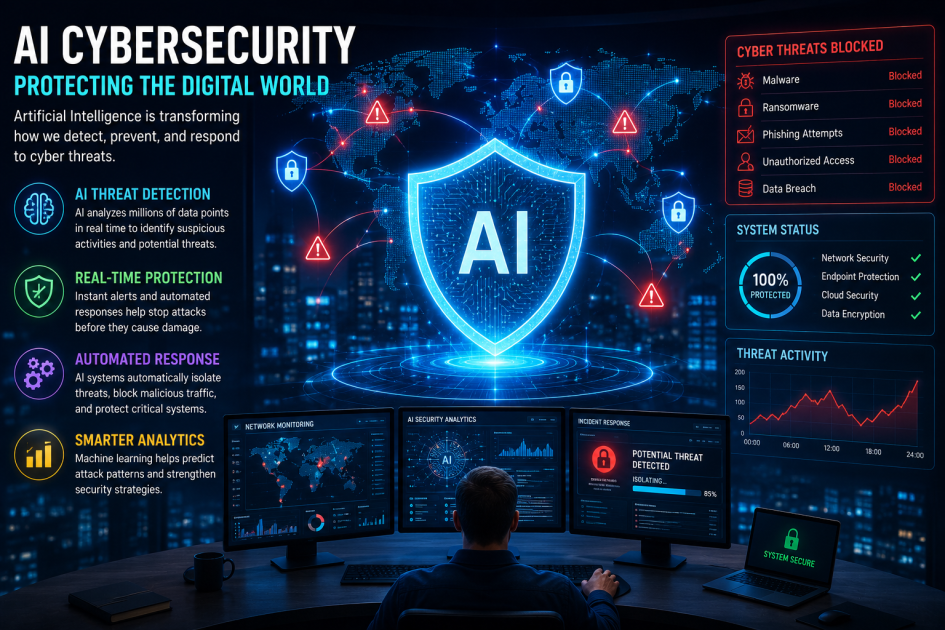
Artificial intelligence helps solve this problem by analyzing vast amounts of data in real time. Unlike traditional security tools that rely primarily on predefined rules, AI systems can identify unusual patterns, detect suspicious behavior, and recognize potential threats even when they have never been encountered before.
One of the most valuable applications of AI in cybersecurity is threat detection. Machine learning algorithms can continuously monitor networks, devices, and user activity to identify signs of malicious behavior. If an employee account suddenly attempts to access sensitive information from an unusual location, an AI-powered system can flag the activity immediately.
Speed is one of the biggest advantages of artificial intelligence in cybersecurity. A cyberattack can spread across an organization within minutes, causing significant damage before human analysts have time to react. AI systems can detect and respond to threats almost instantly, reducing the potential impact of an attack.
Many organizations are now using AI-driven security platforms that can automatically isolate compromised devices, block suspicious network traffic, and alert security teams when unusual activity is detected. This automation allows businesses to respond much faster than traditional manual processes.
Phishing attacks remain one of the most common cybersecurity threats worldwide. Cybercriminals use deceptive emails, messages, and websites to trick individuals into revealing sensitive information. Modern AI systems are becoming increasingly effective at identifying phishing attempts by analyzing language patterns, sender behavior, and suspicious links.
Artificial intelligence is also helping organizations improve vulnerability management. Every software application contains potential weaknesses that attackers may exploit. AI-powered security tools can scan systems continuously, identify vulnerabilities, prioritize risks, and recommend solutions before attackers have an opportunity to take advantage of them.
For security professionals, AI acts as a force multiplier rather than a replacement. Cybersecurity experts still play a critical role in investigating incidents, developing security strategies, and making important decisions. However, AI can handle repetitive monitoring tasks, allowing human specialists to focus on more complex challenges.
Despite its advantages, AI cybersecurity is not without risks. Cybercriminals are also beginning to use artificial intelligence to enhance their attacks. AI can be used to create more convincing phishing emails, automate malware development, and identify vulnerabilities more efficiently. This has created an ongoing technological race between attackers and defenders.
Privacy concerns are another important consideration. Since AI security systems often analyze large amounts of user data, organizations must ensure that they comply with privacy regulations and protect sensitive information responsibly.
Looking ahead, experts believe AI will become an essential component of every major cybersecurity strategy. As cyber threats continue to evolve, organizations will need security solutions capable of adapting quickly and responding intelligently. Artificial intelligence provides the scalability and speed required to meet these growing demands.
Governments, financial institutions, healthcare providers, and technology companies are already investing heavily in AI-driven security technologies. The goal is not only to defend against current threats but also to anticipate future attacks before they occur.
In conclusion, AI cybersecurity represents a significant shift in how organizations protect their digital assets. By combining advanced threat detection, automated response capabilities, and continuous monitoring, artificial intelligence is helping security teams stay ahead of increasingly sophisticated cybercriminals. While challenges remain, the growing role of AI in cybersecurity is likely to define the future of digital protection for years to come.